


Opposed Blade Manual Air Damper
An opposed blade manual air damper is a device used in heating, ventilation, and air conditioning (HVAC) systems to regulate and balance airflow within ductwork. It is typically installed in rectangular or square ducts and is operated manually by a handle or quadrant mounted on the exterior of the duct. The opposed blade configuration is designed so that adjacent blades rotate in opposite directions when adjusted, creating a more even distribution of air and a more consistent airflow pattern across the duct cross‑section.The main components of this type of damper include a frame, a series of parallel blades, blade shafts, linkage mechanisms, and a manual control handle or locking quadrant. The frame is usually constructed from galvanized steel or other corrosion‑resistant metals to ensure durability and structural stability. The blades are mounted horizontally or vertically within the frame and are shaped to minimize air resistance and turbulence. Each blade is connected to a shaft that passes through the frame and is linked to neighboring blades through an internal or external linkage system. This linkage coordinates the movement of the blades so that alternate blades rotate in opposite directions.Opposed blade dampers are widely used for air balancing in supply and return duct systems. When partially closed, they maintain relatively uniform air velocity across the duct, which is particularly useful downstream of diffusers, grilles, and registers. This characteristic distinguishes them from parallel blade dampers, which tend to direct air to one side when throttling, making opposed blade designs preferable for balancing rather than on/off control.Operation of the damper is manual, meaning adjustment is accomplished by physically moving the handle or quadrant. The handle is usually marked to indicate blade position, from fully open to fully closed. Once the desired position is set during system balancing, the handle can be locked in place with a set screw or wing nut to prevent accidental changes. This simple mechanical control method makes the device reliable and easy to maintain, with no need for power or automatic actuators.Construction options can include various blade profiles, such as roll‑formed, airfoil, or hat‑shaped blades, depending on performance requirements. Seals may be added along blade edges and frame sides to reduce leakage when the damper is closed. Bearings or bushings at the blade shafts help ensure smooth operation and reduce wear over time. Some designs are rated for specific pressure and velocity ranges, enabling use in both low‑pressure comfort systems and higher‑pressure commercial applications.Typical applications include commercial buildings, institutional facilities, and industrial plants where precise airflow balancing is necessary for comfort, energy efficiency, and proper operation of terminal devices. The opposed blade manual air damper plays an important role in commissioning and maintaining HVAC systems by providing technicians with a straightforward means to fine‑tune airflow to different zones and spaces.
Products
Category:
-
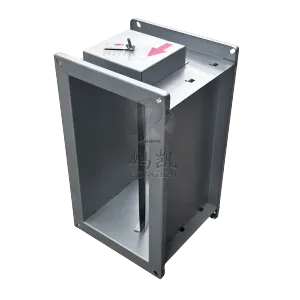
Rectangular Manual Volume Control Damper for HVAC Ventilation Systems
Category: DampersBrowse number: 10Number:Release time: 2026-02-10 11:08:37The Manual Volume Control Damper is a fundamental airflow regulation component installed in building HVAC and ventilation duct systems to balance airflow distribution, adjust supply and return air volumes across different zones, and isolate individual duct branches for maintenance or system reconfiguration. Operated entirely by hand via an external handle, handwheel, or pull-cord mechanism, the Manual Volume Control Damper requires no electrical power or control signal, making it a highly reliable and cost-effective solution for airflow management in commercial, industrial, and residential ventilation systems. The opposed blade design allows stepless adjustment from fully closed to fully open across a 0 to 90 degree range, with a positive locking device securing the blade at any set position to prevent movement from duct air pressure. Available in galvanized steel, aluminum alloy, and stainless steel frame configurations to suit standard ventilation, cleanroom exhaust, kitchen exhaust, and industrial ventilation environments, the HVAC Duct Airflow Balancing Damper is manufactured to GB 50738-2011 and GB 50243-2016 standards and is widely applied in office buildings, shopping centers, hotels, hospitals, schools, industrial facilities, and residential high-rise projects across Southeast Asia and global markets.
News
Category:
No search results found!
Case
Category:
No search results found!
Video
Category:
No search results found!
Download
Category:
No search results found!
Job
Category:
No search results found!
Featured Products
No search results found!



 Phone
Phone